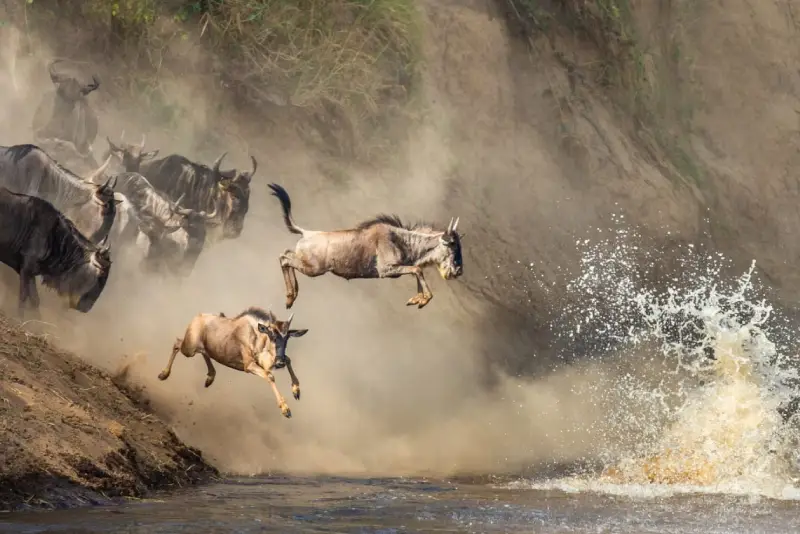
The best time to see the Great Wildebeest Migration depends on what you want to witness: choose January to March for the dramatic calving season in the southern Serengeti, July to October for the main northward migration and Mara River crossings, or November to December for greener landscapes and the herds’ return south.
That is the most important thing to understand before booking a Great Migration safari.
There is no single week when the migration “happens.” The Great Wildebeest Migration is a continuous, year-round movement of wildebeest, zebra and other grazing animals through the Serengeti-Mara ecosystem, driven largely by rainfall, fresh grass and water availability.
For most first-time safari travelers, however, the biggest question is more specific:
When should I go to see the famous wildebeest river crossings?
If that is your priority, August and September are among the strongest months to target northern Serengeti and the Maasai Mara, although crossings are never guaranteed on a particular day. National Geographic currently identifies August and September as peak months around Kogatende in the northern Serengeti, while Kenya’s official tourism platform highlights July to October as the main migration period in the Maasai Mara.
Great Wildebeest Migration at a glance
| What you want to see | Best time | Best area |
|---|---|---|
| Wildebeest calving | January–March | Southern Serengeti / Ndutu |
| Newborn calves & predators | February–March | Ndutu & southern Serengeti |
| Herds moving north | April–June | Central & Western Serengeti |
| Grumeti River crossing | May–July | Western Serengeti |
| Mara River crossings | July–October | Northern Serengeti & Maasai Mara |
| Peak crossing opportunity | August–September | Kogatende / Maasai Mara |
| Herds returning south | October–November | Northern to Central Serengeti |
| Green-season herds | November–December | Central & southern Serengeti |
The precise timing changes from year to year because the animals respond to rainfall and vegetation rather than a human calendar.
What is the Great Wildebeest Migration?
The Great Wildebeest Migration is the enormous annual movement of roughly 1.3–1.5 million wildebeest, accompanied by hundreds of thousands of zebra and gazelles, through the Greater Serengeti-Mara ecosystem. Tanzania’s national park authority currently describes the wider migration as involving more than two million animals when the accompanying grazers are included.
The animals continually search for:
- Fresh grazing
- Water
- Nutrient-rich grass
- Suitable calving grounds
- Seasonal rainfall
The result is one of the planet’s most extraordinary wildlife cycles.
But the migration isn’t simply a line of animals moving from Tanzania to Kenya.
It is a circular ecological process.
The herds spend part of the year on the southern Serengeti plains, move through central and western areas, travel north toward the Mara ecosystem, and eventually begin returning south as rainfall and fresh grazing draw them back and can be experienced on a Hot-Air Baloon Safari as well.
When is the best time to see the Great Wildebeest Migration?
For the classic migration experience, July through October is the most popular period.
For the best chance of seeing dramatic Mara River crossings, I would generally prioritize August and September.
For the best overall wildlife drama, however, February can be just as compelling because the southern Serengeti becomes a vast calving ground, attracting predators including lions, cheetahs and hyenas.
Tanzania’s current tourism material highlights January–March as the calving period, while National Geographic identifies February and March as particularly strong months for seeing newborn wildebeest and predator interactions around Ndutu.
So the real answer is:
Best month = depends on the experience you want.
January: the migration settles in the southern Serengeti
January is an excellent time to experience the beginning of the calving season.
The herds are concentrated around the nutrient-rich short-grass plains of the southern Serengeti and Ndutu area.
This is not the month to book if your only objective is a Mara River crossing.
It is, however, an excellent period for travelers interested in:
- Large concentrations of wildebeest
- Green landscapes
- Newborn calves
- Predators
- Photography
- Fewer peak-season crowds
The southern Serengeti becomes particularly important because the grass provides the nutritional conditions needed for mothers and newborn calves.
February: arguably the best month for wildebeest calving
If you want to see the Great Migration’s most intimate side, February deserves serious consideration.
This is when the southern Serengeti and Ndutu region can become a spectacular wildlife nursery.
TANAPA’s 2026 tourism publication describes January to March as the calving period and highlights the enormous number of births occurring during the peak.
The spectacle is not just about baby wildebeest.
Newborn calves attract predators.
Lions, cheetahs, hyenas and other predators take advantage of the abundance of vulnerable young animals, creating exceptional opportunities for wildlife photography and predator-prey encounters.
Best for:
Calving + predators + photography + green Serengeti
If you want an alternative to the heavily marketed river-crossing safari, February is one of the most compelling choices.
March: calving continues, but the journey is beginning to change
March can still provide excellent calving and predator viewing in the southern Serengeti.
As rainfall patterns change and the grass is gradually consumed, the herds eventually begin shifting toward the western and central Serengeti.
For photographers, March can provide a particularly attractive combination of:
- Green landscapes
- Newborn animals
- Dramatic skies
- Predators
- Large herds
It is also worth remembering that wildlife movements are not synchronized perfectly with the calendar.
Rainfall can shift the timing.
April: the migration begins moving north
April marks a transition.
The great mass of wildebeest begins pushing away from the southern plains and moving northward.
This is a fascinating period for travelers who want to follow the migration rather than simply watch a river crossing.
The landscape can remain beautifully green, although rain can affect road conditions.
For travelers willing to accept wetter conditions, April can offer excellent photographic opportunities and fewer visitors than the peak migration months.
May: Western Serengeti and Grumeti
By May, the migration increasingly moves through the central and western Serengeti.
This is when the Grumeti River becomes relevant.
The Grumeti crossings are less famous internationally than the Mara River crossings, but they are an important part of the migration cycle.
National Geographic describes the herds reaching the Western Corridor around May–June before continuing toward the northern Serengeti and Kenya.
Best for:
- Western Serengeti
- Herd movement
- Green-season scenery
- Lower visitor pressure
- Photography
June: one of the most underrated months
June is an excellent month if you want to see large herds without necessarily paying the premium associated with peak northern migration season.
The animals are moving through the Western Corridor and toward northern Tanzania.
Depending on rainfall and conditions, you may witness dramatic river activity around the Grumeti area.
The advantage is that June allows you to experience the migration as a journey, rather than simply waiting at a famous crossing point.
July: the northern migration begins
July is when migration excitement really begins to build.
The herds move toward the northern Serengeti and increasingly toward the Kenya-Tanzania border.
This is the beginning of the classic Mara River migration season.
Kenya’s official tourism platform identifies July to October as the primary Maasai Mara migration period.
However, July can be less predictable than many promotional articles suggest.
Some herds may still be in Tanzania.
Others may already be moving toward Kenya.
And the timing of the first major river crossings depends on rainfall, water levels and herd movement.
July is best for:
Early northern migration + large herds + fewer peak-season crowds than August/September
August: one of the best months for the Great Migration
If a client tells me:
“I want to see wildebeest crossing the Mara River.”
August is one of the first months I would consider.
The northern Serengeti and Maasai Mara can hold enormous concentrations of migrating animals, and the pressure of finding fresh grazing can bring herds toward the river.
National Geographic identifies August and September as peak periods around Kogatende in northern Serengeti for travelers hoping to witness river crossings.
But here’s the part many websites don’t tell you:
You cannot book a Mara River crossing like a scheduled event.
There may be thousands of wildebeest near the river and no crossing that day.
A herd may gather for hours and turn away.
Another group may cross at a different location.
Rain can change everything.
That unpredictability is part of what makes the experience genuinely wild.
September: perhaps the best balance for river crossings
September is another excellent month for the northern migration.
If your priority is:
Mara River crossings + predators + large herds + classic migration photography
September deserves to be near the top of your list.
The animals may remain in the Mara ecosystem while grazing across the reserve and surrounding areas.
National Geographic’s current Serengeti guide identifies August and September as the peak period for crossing-focused trips around Kogatende.
But don’t make this mistake
Do not book a two-day safari simply because a website says “September is migration season.”
The migration is enormous.
The herds can be dispersed across a huge area.
If river crossings are your main objective, spend several nights in the appropriate migration zone.
More time on location = more opportunities to respond when the animals move.
October: the migration begins turning south
October can still provide excellent migration viewing.
The herds begin responding to changing rainfall and grazing conditions and gradually start moving back toward Tanzania.
National Geographic describes the return south beginning around October as the cycle continues.
This makes October an interesting compromise.
You can potentially experience:
- Northern Serengeti wildlife
- Remaining Mara herds
- Predators
- Changing landscapes
- Beginning southward movement
It may also offer a less intense atmosphere than the height of August.
November: follow the herds south
November is often overlooked.
As the short rains arrive, the herds begin returning toward central and southern Serengeti.
For travelers who don’t require river crossings, this can be an excellent time to experience the migration without building the entire safari around one dramatic event.
National Geographic notes that rainfall can cause the herds to move unpredictably, including temporary back-and-forth movement.
December: the migration prepares for another cycle
By December, many wildebeest have reached the central and southern Serengeti.
The cycle begins preparing for another calving season.
This is a very different migration experience from August.
Instead of focusing on river crossings, you are watching the ecosystem reset.
Best month for the Mara River crossing
If your dream is to watch wildebeest plunge into the Mara River, target:
August–September
But ideally, allow enough time to improve your odds.
The Kenya Tourism Board identifies July–October as the broader Maasai Mara migration window, while current National Geographic guidance places the strongest crossing-focused period around August and September in northern Serengeti.
The important distinction is:
Migration season ≠ guaranteed crossing day.
The animals decide.
Not the safari calendar.
Is August or September better for the Great Migration?
Both are excellent.
Choose August if:
- You want to target the early-to-peak northern migration
- You want a strong chance of finding herds around the Mara ecosystem
- You prefer the classic migration season
- You are combining Kenya and Tanzania
Choose September if:
- Mara River crossings are your priority
- You want to spend time around northern Serengeti/Kogatende
- You want mature migration activity
- You prefer a slightly later-season safari
I would not claim that September is guaranteed to be better.
Migration timing varies every year.
Where is the best place to see the Great Migration?
The answer depends on the month.
| Month | Recommended area |
| Jan | Southern Serengeti / Ndutu |
| Feb | Ndutu / Southern Serengeti |
| Mar | Southern & Central Serengeti |
| Apr | Central Serengeti |
| May | Western Serengeti |
| Jun | Western Corridor |
| Jul | Northern Serengeti / Maasai Mara |
| Aug | Northern Serengeti / Maasai Mara |
| Sep | Northern Serengeti / Maasai Mara |
| Oct | Northern & Eastern Serengeti |
| Nov | Central Serengeti |
| Dec | Central/Southern Serengeti |
The key is to match the accommodation location to the migration, rather than booking a popular lodge first and hoping the animals happen to be nearby.
Tanzania or Kenya: where should you see the migration?
This depends on what you want.
Choose Tanzania for:
- Southern Serengeti calving
- Ndutu
- Western Corridor
- Grumeti
- Northern Serengeti
- Longer migration-focused itineraries
- Combining migration with Ngorongoro
Choose Kenya for:
- Maasai Mara
- Mara River crossings
- Big Five viewing
- Smaller geographic area for a focused Mara safari
- Combining safari with Nairobi or Kenya’s other destinations
For a traveler with enough time, combining Tanzania and Kenya can provide a more complete migration story.
How many days do you need for a Great Migration safari?
For a migration-focused safari, I recommend at least 4–5 nights in the relevant migration region.
If river crossings are your primary objective, more time is better.
A crossing can happen quickly.
But the waiting can last hours.
National Geographic’s firsthand reporting illustrates just how unpredictable the timing can be, with travelers sometimes waiting many hours for a crossing.
A practical safari structure
Day 1: Arrive in migration region
Day 2: Full-day game drive
Day 3: Full-day migration tracking
Day 4: River/crossing-focused safari
Day 5: Final full-day game drive
Day 6: Depart
This gives your guide flexibility.
Why river crossings are never guaranteed
This deserves its own section because it is one of the biggest misunderstandings surrounding Great Migration safaris.
Wildebeest do not cross the Mara River because tourists have arrived.
They cross when environmental conditions and herd behavior trigger movement.
A herd may:
- Approach the river.
- Gather on the bank.
- Wait.
- Move away.
- Return later.
- Cross at another location.
- Split into smaller groups.
Rainfall, river levels, predators, grazing conditions and herd behavior all influence what happens.
That is why a reputable safari company should never promise:
“You will definitely see a river crossing.”
The honest promise is:
“We will position you in the right area, monitor herd movements and maximize your opportunities.”
That is a much more credible way to sell a migration safari.
Great Migration safari costs: when is it cheapest?
Peak migration months—particularly August and September—can command higher accommodation rates because demand is strong.
If budget matters, consider:
May–June or November
You may still experience large herds while avoiding some of the highest peak-season demand.
January–March can also provide outstanding wildlife viewing, particularly around the calving grounds, although premium camps in prime locations can still be expensive.
The cheapest month is therefore not necessarily the best-value month.
A better question is:
“What wildlife experience can I get for my budget?”
Best time for photography during the Great Migration
For dramatic river-crossing photography:
August–September
For newborns and predator action:
February–March
For green landscapes and atmospheric skies:
November–May
For large herds against dry golden landscapes:
July–October
Photography travelers should also consider where the sun will be, vehicle positioning, dust, riverbank access and the amount of time available, not simply the month.
A professional wildlife guide can make a substantial difference.
Frequently Asked Questions
What is the best month to see the Great Wildebeest Migration?
August and September are among the best months for the classic northern migration and Mara River crossing experience. For calving, choose February.
When do wildebeest cross the Mara River?
Mara River crossings generally occur during the July–October migration period, with August and September commonly regarded as strong months. However, exact crossing dates vary every year.
Can I see the Great Migration in January?
Yes. January is part of the year-round migration cycle, and the herds are concentrated around the southern Serengeti as the calving season approaches.
Is February a good time for a Great Migration safari?
Yes. February is particularly good for calving, newborn wildebeest and predator activity in the southern Serengeti and Ndutu region.
Is September a good month for wildebeest migration?
Yes. September is one of the strongest months to target northern Serengeti and Maasai Mara migration viewing, particularly if river crossings are a priority.
Is October too late for the Great Migration?
No. October can still offer excellent migration viewing, although the herds are increasingly beginning their southward movement.
Can you guarantee seeing a Mara River crossing?
No reputable safari operator should guarantee a specific crossing. The herds respond to natural conditions, and their movements cannot be scheduled precisely.
Is Kenya or Tanzania better for the Great Migration?
Neither is universally better. Tanzania is particularly strong for the southern calving season and the wider migration route, while Kenya’s Maasai Mara is famous for the northern migration and Mara River crossings.
How long should I spend on a Great Migration safari?
For a migration-focused trip, 4–5 nights or more in the relevant region gives you significantly more flexibility than a rushed 1–2 night visit.
Does the Great Migration happen every year?
Yes. It is a recurring ecological cycle, although the timing and precise location of the herds change with environmental conditions.
The best time to see the Great Wildebeest Migration depends on your dream
If your dream is thousands of wildebeest pouring into a river, plan around August or September.
If your dream is newborn calves taking their first steps while predators patrol the plains, choose February or March.
If you want large herds, greener scenery and fewer peak-season crowds, consider the shoulder months.
And if you want to understand the migration rather than simply photograph one moment of it, consider following the cycle across several regions.
That is the real secret to planning a Great Migration safari:
Don’t ask only when the migration happens. Ask where the herds are likely to be, what they are doing, and what experience you want to have when you arrive.
The migration is not an event on a calendar.
It is a living, moving ecosystem.
And the best safari is the one planned around the animals—not around a fixed date.
Plan your Great Migration safari
For official information, use the Tanzania National Parks Authority (TANAPA) and the Official Tanzania Tourism website. TANAPA’s current material provides specific guidance on Mara River viewing and migration-related conservation, while Tanzania Tourism identifies Serengeti as the country’s flagship migration destination.
For Kenya, the Magical Kenya tourism platform identifies July–October as the principal Great Migration period in the Maasai Mara.
If you’re booking through a safari operator, ask three questions before paying a deposit:
- Where will we be staying during the migration?
- How many nights will we spend in the migration zone?
- What happens if the herds move away from our planned location?
The answers tell you much more about the quality of the safari than the words “Great Migration” on an itinerary.
Leave a Reply